
Football for kids remains one of the most popular sports choices: a ball is easy to understand, widely accessible, and often associated by parents with “proper” development. At the same time, the questions are almost always the same:
- what age does it actually make sense to start;
- can a child begin at 2–3 years old, or is that too early;
- is it too late at 8–10;
- how do you avoid overloading a child and killing their interest in sport;
- what is the difference between a regular group program, individual training, and mentorship-based development.
In this article, we will look at how football affects a child’s development, which age stages are worth considering, which common mistakes at the start most often lead to burnout, and how to choose the right training format — including in Dubai, where climate and a multicultural environment matter.
We will also take a separate look at the difference between a traditional football coach and a youth sports mentor, for whom football is just one of the tools for a child’s overall development.
Why Football for Kids Is Valuable Beyond the Goal of Becoming a Professional
A common myth is that football for kids only makes sense if the family is seriously aiming for a sports career. In reality, football builds a foundation that can benefit any child, even if their path ends up being far from professional sport.
Physical Development: Coordination, Endurance, and Overall Health
Football for kids engages the whole body:
- coordination improves as children learn to control their body, the ball, and the space around them;
- endurance and cardiovascular fitness develop through alternating levels of exertion;
- reaction speed, balance, flexibility, and strength all improve;
- the risk of physical inactivity and related health issues decreases.
Before starting regular training, it is useful to have a basic medical check-up. If a child has any chronic health conditions, the training format should be discussed with a doctor in advance. This helps make football a tool for strengthening health rather than a source of overload.
Psychology and Character: Discipline, Confidence, and Learning to Lose
Football for kids is also a school of character:
- discipline develops through arriving on time, following rules, and completing exercises;
- responsibility grows — for one’s actions, one’s position on the field, and the team;
- children learn how to lose by handling setbacks, drawing conclusions, and moving forward;
- self-confidence strengthens through repeated experiences of “I did it” and “I can handle this.”
When coaches and parents take a healthy approach, football becomes a safe training ground for emotions rather than a постоянный source of shame and pressure.
Socialisation Through Football for Kids in Multicultural Dubai
In Dubai, football for kids often takes place in international groups, where one team may include children from different countries who speak different languages. This adds another layer of development:
- social skills — learning how to interact with different people;
- tolerance and adaptability — becoming comfortable with differences in habits and communication styles;
- teamwork — aligning interests, sharing roles, and resolving conflicts.
This is exactly where the role of the specialist becomes especially important: someone who knows how to work in a multicultural environment and build clear, understandable rules for everyone, rather than simply “running drills.”
Football for Kids and Age: How to Know When It’s the Right Time to Start
Age is an important factor, but not the only one. A child’s readiness for football is determined by a combination of physical and psychological development, not just by a number on paper.
Ages 2–4: Introducing Football Through Play and Movement
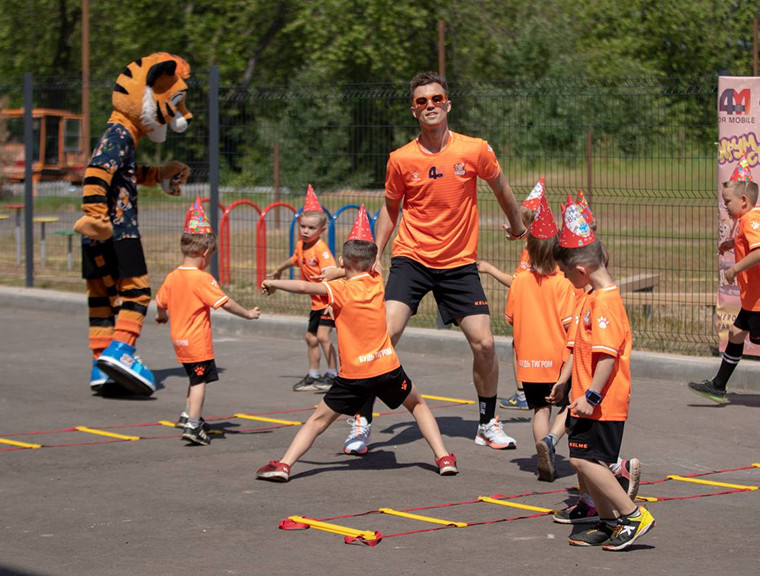
At ages 2–4, football for kids is first and foremost about play with the ball and general physical activity, not structured training:
- short sessions (20–30 minutes) in a playful format;
- simple movement-based games: rolling, catching, kicking the ball, going around obstacles;
- a focus on general physical development: running, jumping, and balance exercises.
Signs that a child is ready for this format:
- they are not afraid of the ball or of noise;
- they can stay focused for 10–15 minutes;
- they show interest in movement rather than clear resistance to activity.
At this age, football is a way to help a child build a positive relationship with movement and coordination, not a step toward a professional career.
Ages 5–7: The Best Time to Start Football on a Regular Basis
At ages 5–7, football for kids can already become a regular activity:
- coordination is more developed, and the child can understand and follow instructions;
- attention span increases, making 45–60 minute sessions possible;
- interest in shared play and first team-based formats begins to emerge.
At this stage, the following usually works well:
- 2–3 sessions per week, 45–60 minutes each;
- a combination of basic technique, ball games, and general physical training;
- mini-matches such as 2v2, 3v3, or 4v4, without a rigid focus on the score.
What matters most is that football at this age remains a joyful activity. Excessive pressure to achieve results at 5–7 years old is far more likely to lead to burnout than to stronger motivation.
Ages 8–10: Football for Kids Who Start Later, but More Consciously
Starting at 8–10 is completely normal, especially if there was no stable opportunity to join sports programs earlier. At this age:
- children understand better why they are doing sport;
- it becomes easier to discuss goals such as health, social connection, or competition;
- they are able to handle more complex exercises and game-related tasks.
If a child starts football later than their peers, an effective combination is often:
- group or academy sessions,
- plus targeted individual training to build basic skills and confidence.
This approach helps reduce the feeling of “I’m worse than everyone else” and levels the playing field more quickly.
Ages 11+: Football for Kids and Teens — Being Honest About Goals and Pathways
After age 11–12, it becomes important to discuss expectations honestly:
- if the goal is health, confidence, and team socialisation, it is absolutely fine to start football later;
- if the goal is high-level athletic performance, it will require more time, greater training loads, and more resources.
At this stage, football for kids usually also includes:
- more serious general physical training;
- additional work on strength, endurance, and speed;
- in some cases, mentorship and individual formats where the teenager is supported not only technically, but emotionally as well.
The key is not to place unrealistic plans on a teenager that come from someone else, and to preserve their sense of choice.
Basic
For families looking for regular training and quality mentorship.
Sessions per month
Each training session lasts 50 minutes.
900 AED / month
Included:
- 4 / 8 / 12 Training Sessions
- Welcome Kit
- TIger Progress Book
- Family Communication
Plus
best value
For families who want the mentor to take an active role in their child's development.
Sessions per month
Each training session lasts 50 minutes.
1 300 AED / month
Included:
- Development Plan
- Monthly Progress Report
- Tiger Time
- Priority Registration
Elite
maximum support
For families seeking comprehensive long-term mentorship across every key area of development.
Sessions per month
Each training session lasts 50 minutes.
2 000 AED / month
Included:
- Tiger Day
- Parent Consultation
- Priority Planning
- Family Strategy Session
- Yura Tiger Privileges
The First Season in Youth Football: How to Start Without Burnout
The first season is a critical period that often shapes a child’s attitude toward sport as a whole.
Starting Formats in Youth Football: Group Classes, Mini-Groups, and Individual Training
The available formats can vary:
- large group classes — bigger groups, fixed schedules, less individual attention;
- mini-groups (3–6 children) — more direct contact with the coach and greater flexibility for the group’s needs;
- individual training — one-on-one sessions built around the specific needs of the child.
An individual format can be especially useful when:
- the child is very shy and struggles in a group setting;
- there are clear gaps in coordination, attention, or behaviour;
- the child is starting football later than peers and needs to catch up more quickly.
These sessions are often included in mentorship-based programs, where sport is only one part of a broader development journey, and football is used as one of the tools.
Training Load and Schedule in Youth Football by Age and Dubai’s Climate
A general guideline for training load:
- ages 2–4: 1–2 short play-based sessions per week;
- ages 5–7: 2–3 training sessions per week, 45–60 minutes each;
- ages 8–10: 3 training sessions per week, sometimes with participation in match days;
- ages 11+: the volume depends on the child’s goals and overall condition.
In Dubai, climate must be taken into account:
- reduce intensity during extremely hot months;
- choose morning or evening time slots;
- use indoor facilities during periods of intense heat;
- monitor hydration and overall well-being.
Football for kids should adapt to the environment, not ignore it.
The Role of Parents in the First Season: Support Without Pressure
Parents’ behaviour during the first season influences motivation no less than the training itself.
| Helps | Harms |
|---|---|
| interest in the child’s experience (“What did you enjoy?”, “What felt the hardest?”), rather than focusing only on results | regularly analysing mistakes after every session |
| supporting effort, not just goals and wins | shouting and putting pressure on the child during games |
| paying attention to sleep routine and nutrition | comparing the child with other kids |
The parents’ task is to remain the child’s allies and help them get through the first season without feeling like they are constantly being tested.
Common Mistakes at the Start of Youth Football That Kill Motivation
Some scenarios almost inevitably lead to a drop in interest.
Football for Kids Driven by Parents’ Ambitions, Not the Child’s Interest
When the main motive is to fulfil the parents’ unrealised dreams rather than the child’s genuine interest, football becomes a tool of pressure.
Signs of this include:
- the child goes to training “because they have to,” not “because they want to”;
- any attempt to discuss changing the format is treated as “ludeness” or lack of discipline;
- the child’s worth is judged mainly through success or failure in sport.
In the long run, this almost always damages both motivation and the parent-child relationship.
Overload in Youth Football: Too Early, Too Much
Another common mistake is excessive volume at an early age:
- 5–6 training sessions a week for children aged 6–7;
- constant tournaments with no breaks;
- additional parallel sports or activity programs.
The result is emotional and physical burnout. At that point, football stops being associated with joy and starts feeling like constant pressure.
Comparison and Criticism: How Football Becomes a Source of Shame
Phrases like “Look how he plays,” “You let the team down,” or “You always ruin everything” create the feeling in a child that “something is wrong with me.”
A far healthier approach is to:
- compare the child to their past self (“You used to get tired after 10 minutes, and now you can handle a full half”);
- highlight progress in specific skills;
- help them look for solutions instead of devaluing their effort.
A Toxic Coach in Youth Football: When It’s Time to Leave
Sometimes the problem is not the child or the family, but the environment itself:
- shouting and humiliation in front of the whole group;
- harsh labels and mocking mistakes;
- ignoring the child’s emotional state.
In this case, changing the coach or the training format is not being difficult — it is a matter of psychological safety. Football should not be a place where a child feels afraid.
Constantly Changing Clubs and Programs
The opposite extreme is moving endlessly from one club or coach to another:
- the child never has time to adapt;
- stable bonds with the team and the adult leading them do not form;
- progress gets interrupted in short, unfinished stages.
In most cases, it makes more sense to evaluate progress over the course of a season rather than changing everything after just a couple of disappointing sessions.
Football for Kids in Dubai: How to Choose the Right Coach and Training Format
Choosing a coach and training format in Dubai is more complex because of the climate, the pace of life, and the multicultural environment. It is important to look not only at sporting goals, but also at the specialist’s overall approach.
Ages 2–4: Introducing Football Through Play and Movement
At ages 2–4, football for kids is first and foremost about play with the ball and general physical activity, not structured training:
- short sessions (20–30 minutes) in a playful format;
- simple movement-based games: rolling, catching, kicking the ball, going around obstacles;
- a focus on general physical development: running, jumping, and balance exercises.
Signs that a child is ready for this format:
- they are not afraid of the ball or of noise;
- they can stay focused for 10–15 minutes;
- they show interest in movement rather than clear resistance to activity.
At this age, football is a way to help a child build a positive relationship with movement and coordination, not a step toward a professional career.
Ages 5–7: The Best Time to Start Football on a Regular Basis
At ages 5–7, football for kids can already become a regular activity:
- coordination is more developed, and the child can understand and follow instructions;
- attention span increases, making 45–60 minute sessions possible;
- interest in shared play and first team-based formats begins to emerge.
At this stage, the following usually works well:
- 2–3 sessions per week, 45–60 minutes each;
- a combination of basic technique, ball games, and general physical training;
- mini-matches such as 2v2, 3v3, or 4v4, without a rigid focus on the score.
What matters most is that football at this age remains a joyful activity. Excessive pressure to achieve results at 5–7 years old is far more likely to lead to burnout than to stronger motivation.
Questions to Ask a Youth Football Coach Before the Season Starts
It is helpful to discuss the following:
- How do you structure the training process for children of our age group?
- How do you respond if a child feels shy, anxious, or struggles to engage?
- How do you work with mistakes and losses?
- How will you keep us informed about progress and any difficulties?
- What does the first month and the first season look like in your system?
The answers will give you a clearer picture not only of the football program itself, but also of the coach’s broader approach to a child’s development.
Football for Kids and Individual Training: Schedules and Mentorship Packages
Alongside traditional group programs, Dubai is seeing growing demand for individual and mentorship-based formats, where football for kids is used as one of the tools for physical and emotional development.
When Group Football Is Enough — and When It Is Not
A group format is usually a good fit when:
- the child is ready to interact with peers;
- there are no major difficulties with coordination or attention;
- there is no pronounced anxiety or resistance toward being in a group.
Individual work is more often needed when:
- the child is starting football later and needs to build the basics more quickly;
- the child is very reserved or afraid of being judged;
- there are behavioural or processing особенностей that require a more adapted approach.
Individual Football Training for Kids: Who Really Needs It
Individual training can help a child:
- improve specific physical skills such as coordination, endurance, and technique;
- work on discipline, attention, and confidence;
- prepare for a more comfortable transition into a group setting.
These sessions can also be part of mentorship programs, where work is done not only on the body, but also on emotions and behaviour.
Football for Kids as Mentorship: Levels of Involvement and Packages
In mentorship-based formats, sport is part of a broader developmental process:
- setting goals together with the child and the family;
- supporting adaptation, school routines, and communication;
- using football and other activities as a “training ground” for character and life skills.
I’m Yury Tsyrkunov, and I work in Dubai as a youth sports mentor. I help children grow through movement, play, and carefully integrated elements of football, without turning sport into a race for results. On this website, I’ve described the different formats I offer — from gentle introductions and one-off sessions to more involved long-term support — so you can choose the level of involvement and session frequency that fits your family’s rhythm.
All options for duration, structure, and pricing are collected in the Prices & Packages section, where you can compare the formats and submit a request for your first meeting.
Schedule Availability for Football for Kids in Dubai
When choosing individual or mentorship-based formats, parents usually look at:
- available time slots (morning / afternoon / evening);
- locations (home, indoor facility, outdoor field);
- whether a trial session is available.
Football for Kids: How to Know You’re Doing It Right
Here are the signs of a healthy process:
- the child is generally willing to attend sessions and is not living in constant fear of being judged;
- there is visible progress — not only in technique, but also in confidence, discipline, and communication;
- the family has a realistic understanding of its goals: why football matters for their child specifically;
- when needed, parents are ready to adjust the format — reduce the workload, change the environment, or move toward more comprehensive development programs.
Football for kids is not only about goals and tournament tables. In the right setup, it becomes a tool for growth — and, when needed, it can be integrated into broader mentorship and child development programs.
FAQ About Age, Motivation, and Training
-
Yes, if the format is play-based activity with a ball and elements of general physical development, without rigid performance demands. The focus should be on the joy of movement, not on technique or winning.
-
No. For health, socialisation, and confidence, this is still a perfectly suitable age to begin. For more serious sporting ambitions, extra time and investment may be needed, but starting at 9–11 is absolutely possible.
-
In most cases, 2–3 sessions per week, 45–60 minutes each, are enough. Consistency and the quality of the process matter more than the maximum number of sessions.
-
The first step is to understand the reason: tiredness, overload, conflict within the group, fear, or simply lack of interest in the sport itself. Sometimes changing the format or reducing the volume helps; in other cases, switching to a different activity is the better option.
-
The child feels safe, is willing to try, and is not afraid to make mistakes. The training atmosphere is structured and productive, but not humiliating. There is visible progress, a clear process, and a coach who is open to discussing that process with parents.